AI
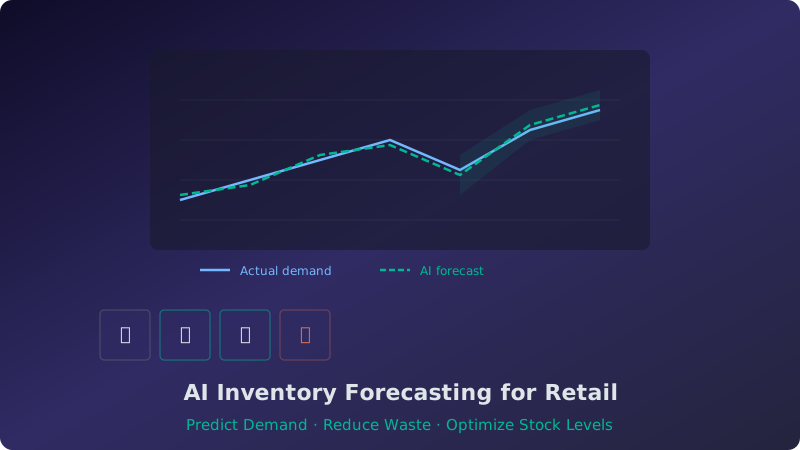
Inventory management is a constant balancing act for small retailers. Order too much and you tie up cash in products sitting on shelves. Order too little and you lose sales to stockouts, disappointing customers who may not come back. In 2026, AI inventory forecasting for small retail is no longer limited to large corporations with data science teams. Affordable tools now use your existing sales data to predict demand more accurately than spreadsheets ever could.
This guide explains how AI inventory forecasting works, which tools fit small retail budgets, and how to get started without a technical background.
How AI Inventory Forecasting Works
Traditional inventory planning relies on simple formulas: average sales per week times lead time, plus a safety stock buffer. AI forecasting improves on this by analyzing more variables:
- Historical sales patterns: Not just averages, but trends, seasonality, and product lifecycle curves.
- External factors: Weather forecasts, local events, holidays, and even social media trends that signal upcoming demand shifts.
- Product relationships: If Product A sells out, does demand shift to Product B? AI can model these substitution effects.
- Supplier lead time variability: Some suppliers are consistently late. AI tracks actual vs. quoted lead times and adjusts reorder points.
The result is a demand forecast that adapts to changing conditions rather than relying on static assumptions. For a broader look at AI in retail operations, see our guide on AI inventory management for small business.
AI Forecasting Tools for Small Retailers
| Tool | Type | Pricing | Best For |
|---|---|---|---|
| Square Inventory (built-in) | POS with basic forecasting | Free with Square POS | Micro-retailers already on Square |
| Shopify Stocky | Inventory planning for Shopify | Free with Shopify | Shopify-based stores |
| inFlow Inventory | Standalone inventory with reorder suggestions | Free for 100 products | Small product catalogs |
| Inventory Planner by Sage | AI-powered demand planning | From $199/month | Growing retailers with 500+ SKUs |
| Netstock | AI demand forecasting + inventory optimization | From $250/month | Multi-location retailers |
| Google Sheets + AI (ChatGPT/Claude) | DIY forecasting assistance | Free | Very small operations, getting started |
The DIY Approach: Using AI Chatbots for Forecasting
If you are not ready for a dedicated forecasting tool, you can get surprisingly useful results by combining your sales data with an AI chatbot. Here is how:
- Export your sales data: Download 12+ months of sales by product from your POS system as a CSV file.
- Analyze patterns: Upload the data to an AI chatbot and ask it to identify seasonal trends, top-selling products, and products with declining demand.
- Generate reorder recommendations: Provide your supplier lead times and desired safety stock level. Ask the AI to calculate suggested reorder points and quantities for your top 20 products.
- Identify slow movers: Ask which products have the lowest inventory turnover rate so you can consider markdowns or discontinuation.
This approach is not as sophisticated as a dedicated tool, but it costs nothing and gives you insights that manual spreadsheet analysis would take hours to produce.
Key Metrics to Track
Regardless of which tool you use, these are the inventory metrics that matter most for small retailers:
- Inventory turnover rate: How many times per year you sell through your average inventory. Higher is generally better, but varies by industry.
- Stockout rate: Percentage of time a product is unavailable when a customer wants it. Target: under 2% for key products.
- Carrying cost percentage: Total cost of holding inventory (storage, insurance, depreciation, opportunity cost) as a percentage of inventory value. Typically 20-30%.
- Forecast accuracy: How closely your predicted demand matched actual sales. Aim for 80%+ accuracy on your top SKUs.
- Gross margin return on investment (GMROI): Gross margin divided by average inventory cost. Tells you which products are actually profitable to stock.
Getting Started: A 30-Day Plan
Here is a realistic timeline for implementing AI inventory forecasting in a small retail business:
- Week 1: Export and clean your sales data. Ensure product names are consistent and categories are correct.
- Week 2: Try the DIY approach with an AI chatbot. Get baseline insights on your top 20 products.
- Week 3: If you use Shopify or Square, explore their built-in inventory analytics. Compare the AI suggestions to your current ordering patterns.
- Week 4: Decide whether a dedicated tool is worth the investment based on the gap between AI recommendations and your current results. If you have 100+ SKUs and complex seasonality, a paid tool will likely pay for itself.
For help building the broader operational infrastructure that supports inventory planning, see our guide on AI automation tools for small business.
Conclusion
AI inventory forecasting does not require a big budget or a data science team to deliver value. Start with what you have — your existing sales data and a free AI chatbot — and you will immediately get better insights than a spreadsheet alone can provide. As your business grows and your product catalog expands, upgrade to a dedicated forecasting tool that automates the process. The businesses that adopt AI forecasting now will have a meaningful cost advantage over competitors still guessing at reorder quantities. Even a 10% improvement in inventory accuracy translates directly to more cash in the bank and fewer lost sales.