AI Agents for Small Business in 2026: What They Can Do and Where to Start
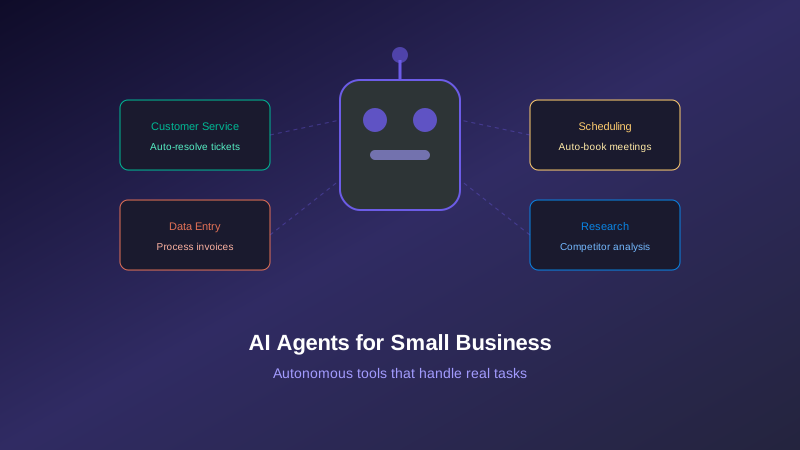
The conversation around AI for small business has shifted. In 2025, most small businesses were asking whether they should use AI tools like ChatGPT. In 2026, the question is different: should you deploy AI agents for small business — autonomous systems that can take actions on your behalf, not just generate text?
AI agents are different from chatbots. A chatbot answers questions. An autonomous AI tool for small business can research competitors, draft and send emails, schedule appointments, update your CRM, process invoices, and take other actions without human intervention for each step. This guide covers what is actually available, what works, and where small businesses should start.
What AI Agents Can Actually Do for Small Businesses
Unlike general AI assistants, agents are designed to complete multi-step tasks autonomously. Here are the use cases that are most practical for small businesses in 2026:
1. Customer Service Agents
The most mature category. AI customer service agents can:
- Answer common questions about hours, pricing, and policies
- Route complex issues to the right human agent
- Process returns and exchange requests based on your rules
- Follow up with customers after purchases
- Handle multilingual support without hiring translators
Tools like Intercom's Fin AI, Zendesk AI Agent, and custom GPT-based agents are all viable options. Our ChatGPT complete guide for small business covers how to build a custom customer service agent using OpenAI's platform.
2. Scheduling and Calendar Agents
AI scheduling agents interact with your calendar, email, and booking systems to manage appointments without back-and-forth emails:
- Read incoming scheduling requests and propose available times
- Automatically add confirmed meetings to your calendar
- Send reminders and follow-up messages
- Reschedule appointments when conflicts arise
Calendly's AI features and Motion's autonomous scheduling are leading options. These agents work well because the task is clearly defined with predictable inputs and outputs.
3. Data Entry and Research Agents
These agents handle information processing tasks that eat up hours of small business owners' time:
- Extract data from invoices and receipts into accounting software
- Research competitors and compile summary reports
- Monitor pricing changes across supplier websites
- Update CRM records based on email and call data
Zapier's AI agents and Make.com's AI automations connect to your existing tools and can perform these tasks on a schedule or trigger basis. For more on integrating AI with your existing stack, see our guide on how to integrate AI tools with existing software.
Available AI Agent Platforms for Small Business
| Platform | Agent Type | Pricing | Best For |
|---|---|---|---|
| OpenAI GPTs + Actions | Custom agents | $20/mo (Plus) + usage | Custom workflows, customer service |
| Zapier AI Agents | Workflow automation | Free tier + $20/mo+ | Data entry, integrations |
| Intercom Fin | Customer support | From $39/mo | Customer service resolution |
| Motion AI | Scheduling | $19/mo | Calendar and task management |
| Make.com AI | Workflow agents | Free tier + $9/mo+ | Multi-app automation |
Where to Start: A Practical Framework
Instead of trying to automate everything, small businesses should follow a focused approach:
- Identify your most repetitive task — What task do you or your team spend the most time on that follows a predictable pattern? This is your best candidate for an AI agent.
- Choose a task with clear success criteria — "Improve customer service" is too vague. "Resolve 40% of Tier 1 support tickets without human intervention" is measurable.
- Start with a pre-built agent — Before building custom agents, try existing solutions from platforms like Intercom, Zapier, or your CRM's built-in AI. Custom agents are powerful but require more setup and maintenance.
- Set up human oversight — For the first 2-4 weeks, review every action the agent takes. This catches errors early and helps you understand where the agent needs guardrails.
- Measure and iterate — Track time saved, error rates, and customer satisfaction. Use this data to justify expanding to additional tasks.
If you are looking at AI agents as part of a broader automation strategy, our guide to automating small business operations with AI provides a framework for prioritizing which processes to automate first.
Cost Expectations
AI agents are more affordable than most small business owners expect, but there are costs beyond the subscription:
- Platform fees — $20-50/month for most agent platforms
- Usage costs — API-based agents charge per action or per token. High-volume tasks can run $50-200/month in usage fees.
- Setup time — Expect 5-15 hours to configure a single agent properly, including testing and iteration.
- Ongoing maintenance — Budget 1-2 hours per month to review agent performance and adjust rules.
For project management specifically, our AI project management tools guide covers agents that can automate task assignment, progress tracking, and reporting.
Conclusion
AI agents for small business have moved from theoretical to practical in 2026. The technology works — but only for well-defined, repetitive tasks. Customer service, scheduling, and data entry are the strongest use cases today. The key to success is starting with one specific task, choosing a proven platform rather than building from scratch, and maintaining human oversight until the agent proves reliable. Small businesses that adopt AI agents incrementally, measuring results at each step, will see the best return on their time and money investment.